The mosquito bucket of doom works
The mosquito bucket of doom is a population control mechanism where you dissolve some Bti (Bacillus thuringiensis israelensis) into a bucket and allow the mosquitoes to lay eggs in these buckets. The larvae then feed on Bti and die.
I tried this method, and it has been unexpectedly effective.
Background
I live in a really wooded area. It’s not swampy, but we have a lot of mosquitoes.
I didn’t take the baseline measurements in the previous years, but on hot months like June, July, August, and partially September, it would be quite literally impossible to spend any time out in the yard – in the morning, while the sun is not super strong yet, you get bitten by dozens upon dozens of mosquitoes. Then the sun is super strong and it’s impossible to be outside. Then, in the afternoon or, god forbid, evening, there are swarms and swarms of mosquitoes, which make it impossible to be out and about.
According to my own guess, I would, at all times, be surrounded by at least 20 or 30 mosquitoes. Killing 30 mosquitoes per hour was not uncommon. That’s one mosquito every two minutes!
Nesting and proximity
Mosquitoes lay eggs in open water, and the tricky thing is that the Aedes albopictus (so called “tiger mosquitoes”) lay eggs in very small bodies of water (like a bottle cap, or the inside of a tire), so even if you treat large bodies of water (like swamps), you still get the same issue.
Mosquitoes also don’t travel very far. Estimates differ, but e.g. Ae. aegypti frequently fly for less than 100 m, with the average distance being 106 m.

Moore & Brown, in their meta-analysis of mosquito flight distances, observe:
We provide an overall estimate of 106 m as the Ae. aegypti average travel distance that can be essential for risk assessment and intervention development.
I don’t think I have Ae. aegypti here, but Ae. albopictus, but I can’t find as many studies on them as for aegypti.
According to this study, the numbers are a bit larger, but not by a lot:
In 2008, we carried out 3 MRR experiments within a highly urbanised area in the city of Rome (central Italy) to analyse dispersal of florescent dusted Ae. albopictus females released after blood-meal and recaptured by sticky traps (STs), and obtained flight ranges of 90% of the released females ranging between 168 and 236 m17.
But according to this study, the numbers are a bit larger.
We found that 77.5% of the recaptured Ae. albopictus individuals flew further than 250 m
In any case, we know that mosquitoes definitely don’t fly for miles and miles before biting you. In fact, if you’re under a constant attack, the mosquitoes biting you were probably born close by, and the first thing you should do is check your entire yard for stagnant water.
I once moved a tire that had a bit of water sloshing around, and saw maybe 50, if not more, mosquitoes fly out of that thing. So step 0 is always: remove any stagnant pools of water. Common culprits are clogged drains, buckets, tires, or random concave objects that allow water to pool in.
I know I’m repeating myself, but I’ve said this to numerous people and it doesn’t really register until you say it a couple of times: the mosquitoes that are biting you were likely born within 100 meters from the place that they bit you. 1
Bucket of doom: pro tips
I watched this video:
This is another example of a video in the “software engineer talks about a non-software topic and does a much better job than others” genre.
In short:
- Big bucket filled with water.
- Place it somewhere relatively out of the way.
- Add some leaves to make it more like a swamp.
- Add a stick that protrudes out so that any unfortunate rodents can climb out.
- Add a rain cover of some kind (to prevent dilution in case of heavy rain).
- Add a teaspoon of Bti every month.
Usually people fail one or more of these things, and that’s what makes the bucket less than effective.
My setup
I didn’t build in my rain cover but placed the buckets themselves under a covered patch of the yard, which had the same effect. Here’s the bucket in action, ready to sink the population:
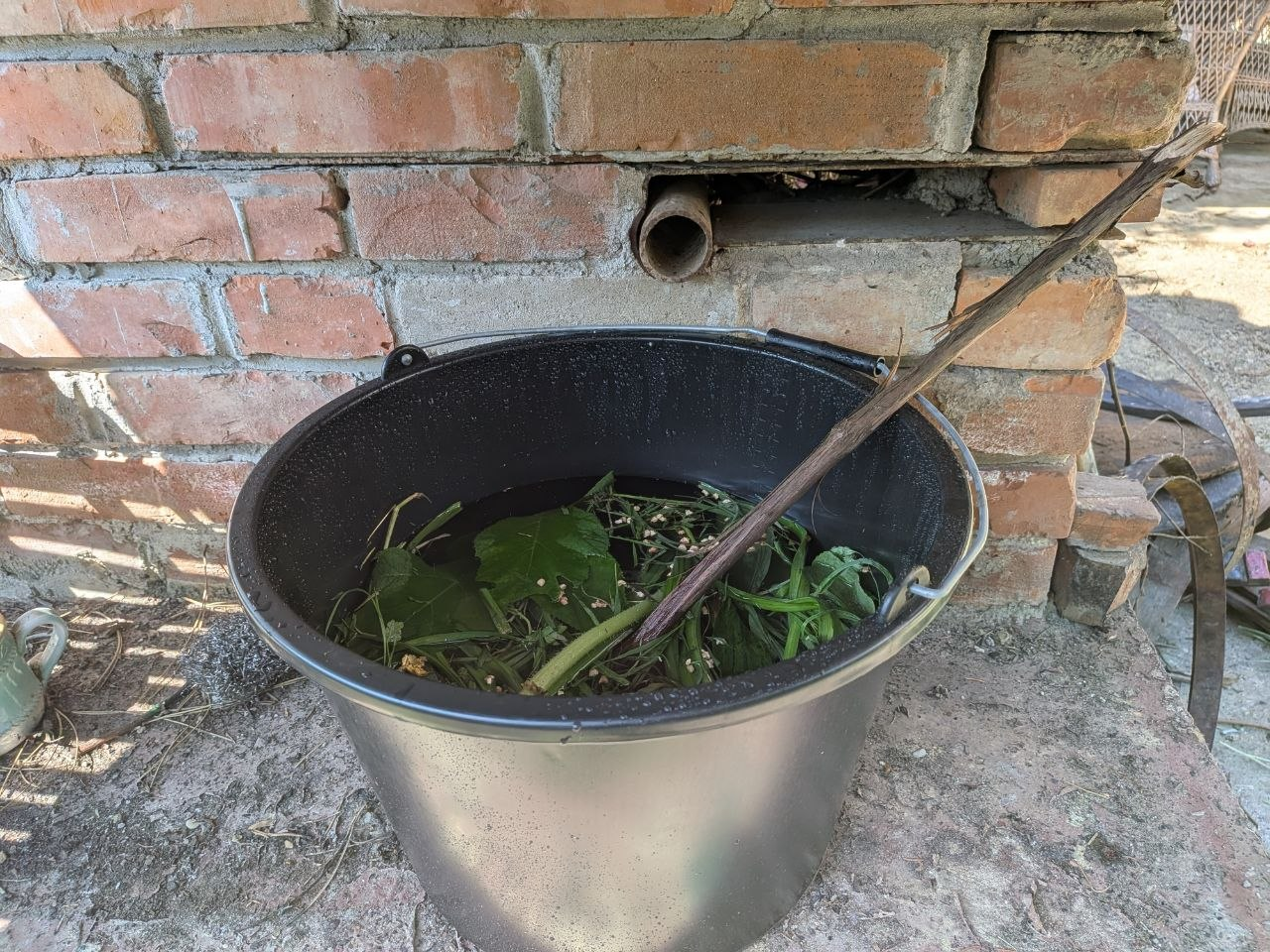
This was the first month, but I put in too much greenery, which started decomposing and smelling bad. You don’t need that much, you can add a couple of leaves and that will be quite enough.
I set up a total of five buckets, three surrounding the house, and two covering the farther sections of the yard, closer to the forest.
I thought about setting the five buckets around the house to form a pentagram, and also considered a salt circle in addition, to simultaneously protect against pests from the supernatural realm, but ultimately practicality won over the very fun notion of having enclosed my house in a demon trap.
Safety concerns
I haven’t done more research than reading some Wikipedia articles and a couple of Youtube videos, but apparently, Bti is completely non-toxic to most2 other lifeforms. I.e. birds can drink the same spicy water, and they’ll feel exactly nothing. Dogs and cats can do the same, and they won’t have any harmful effects.
I didn’t test this with my dogs, and I have placed these buckets on slightly elevated positions so that my dogs don’t, in fact, drink the swamp water, but I wouldn’t worry even if they did.
I have observed birds bathe in and drink this water, and I haven’t observed any dead birds around my property, so for what it’s worth, I can corroborate that Bti indeed is not harmful to other animals.
Buying Bti
Depending on your region, you may or may not have access to Bti, or you may need special licensing, or it may even be wholly unregulated. In Croatia, it seems that nobody has even heard of this, because as far as I can tell, there’s just no regulation that says either “this is ok for general use” or “you need a special license for this” or anything.
Also, don’t buy other strains of BT. There’s other strains that attack other insects, like Btk. I don’t know what this is used for in practice, but it’s not the thing you want. You want the Israeli bacteria.
I bought mine from the French webshop “Ma Lutte Bio”, and here’s the exact link (I got the 500 g package).
I just have to comment on the following facts:
- The most effective method of killing pests is a bacteria that has “Israeli” in its name.
- It is being sold by a French web shop that is literally called “My Struggle”.
I feel like there’s a lot of political innuendo here, but maybe I’m just too online.
Results
It’s been two months now, the weather is quite hot, and the mosquitoes are… largely absent.
I can go out in the evening, and there’ll be one or two mosquitoes here and there. In the last two months, I’ve killed maybe 20 mosquitoes in total. I used to average that in an hour.
I also thought: maybe it’s an accident, I know that sometimes the City will spray against mosquitoes in the beginning of the summer, so maybe I’m observing the results of their effort, not mine. A quick stroll 100 meters down into the woods convinced me otherwise. Instantly I was attacked by dozens upon dozens of mosquitoes. So it’s not the region-wide spraying, it is actually my buckets that are doing the work.
The bucket of doom absolutely works, and I will maintain it every summer from now on.
Song unrelated:
The studies deal with releasing and recapturing mosquitoes, not with mosquitoes being born and then being captured. But I don’t think we have any knowledge of mosquitoes developing from their larvae, then flying a much larger distance than this observed average, and only then settling for the average of 106 m. So for practical purposes, the 106 m distance applies also to the distance flown from the breeding ground to the point of biting. ↩︎
Apparently it’s toxic to black flies too. In my book, that’s good. ↩︎